Time:
A gold CIP plant, also known as a carbon-in-pulp system, is one of the most effective methods for extracting gold from ore using cyanide leaching and activated carbon adsorption. Gold CIP is one of the methods of gold extraction by cyanidation. It is a carbon adsorption process for monovalent gold cyanide [KAu (CN)2] after the cyanide leaching of gold-bearing materials. During this process, finely ground ore is mixed with water and sodium cyanide to form a slurry. Gold then dissolves into the solution. The dissolved gold ions are then adsorbed onto activated carbon particles within large tanks.
The cyanide pulp enters the stirring adsorption tank. This tank is also called the carbon slurry tank. Carbon is added to the leaching tank. The carbon adsorbs the gold in the pulp and becomes gold-loaded carbon. After the adsorption is completed, the carbon and the pulp are separated by a carbon extraction screen. The loaded carbon is subsequently transferred to elution columns. There, it undergoes desorption and regeneration. Continuous operation ensures steady gold recovery rates and optimal reagent use. This makes it highly suitable for large-scale CIP plant gold mining machine setups.

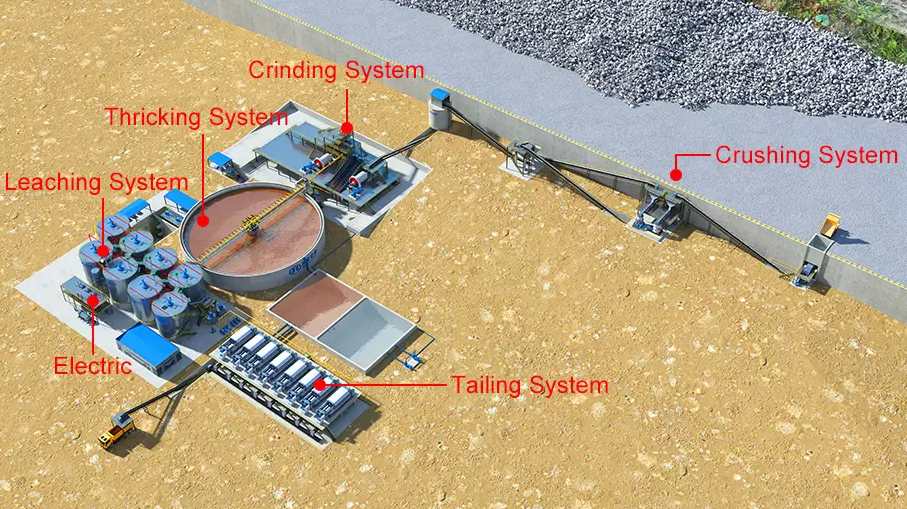
The typical CIP gold processing plant consists of several integrated units. Leaching tanks are used first. Cyanidation dissolves the precious metal from ore particles in these tanks. Then, adsorption tanks containing activated carbon capture dissolved gold through physical and chemical interactions.
After adsorption, elution systems strip gold from loaded carbon. They use caustic solutions under high temperature and pressure. In a closed system, gold-loaded carbon can be rapidly desorbed and electrolyzed into muddy gold and lean carbon under high-temperature and high-pressure conditions. The stripped solution moves into electrowinning cells. The precipitated gold is then melted into ingots in smelting units.
Continuous operation of a CIP plant requires efficient management of activated carbon circulation between tanks. The main challenges include maintaining consistent activity over multiple cycles. They also include preventing attrition losses during transfer. Another challenge is minimizing leakage through interstage screens or pumps. Carbon inventory control also plays a vital role. It helps balance adsorption efficiency against operational costs.
Efficient movement of activated carbon between stages is essential for stable CIP mining performance. Interstage screens allow slurry flow. They retain coarse carbon granules within each tank at the same time. Pneumatic or hydraulic pumps transfer loaded carbon smoothly between adsorption stages. This happens without excessive wear. Regular screening helps remove fine or broken particles. Such particles could reduce performance or cause blockages during transfer operations.
After several cycles, activated carbon loses its adsorption capacity. This happens due to fouling by organic matter or mineral coatings. The desorbed lean carbon is first soaked in a 1.5% ~ 2.0% nitric acid solution for 24 hours. This step removes calcium. Then it is washed with clean water until neutral. After that, it returns to the adsorption cycle. Thermal reactivation at controlled temperatures restores pore structure and surface activity. It does this without damaging the carbon’s physical integrity. Proper regeneration not only enhances recovery rates but also reduces reagent consumption. These are key metrics for sustainable CIP plant gold operations.
Elution represents one of the most critical stages in CIP gold processing plant design. In a closed system, gold-loaded carbon can be rapidly desorbed and electrolyzed into muddy gold and lean carbon under high-temperature and high-pressure conditions. Four methods are currently available for desorption. The first uses hot caustic sodium cyanide solution for desorption. The second uses a low-concentration caustic sodium cyanide solution plus alcohol desorption. The third uses desorption with acidic sodium cyanide solution under heating and pressure conditions. The fourth uses the desorption of a high-concentration caustic sodium cyanide solution. The resulting pregnant solution flows into electrowinning cells. Metallic deposits form on cathodes there before final smelting.
Temperature, pressure, and chemical concentration must be precisely controlled throughout this stage. This achieves maximum gold recovery yield while preventing structural damage to activated carbon granules.
Raising operating temperatures accelerates desorption rates by increasing molecular mobility within pores. This occurs without harming the structural integrity of the carbon. Controlled pressure ensures consistent flow through elution columns. It also prevents vapor lock or uneven distribution across beds.
Balancing caustic soda and cyanide concentrations optimizes stripping efficiency during continuous operation cycles. Periodic replacement of elution solutions prevents impurity buildup. Such buildup may hinder subsequent desorption steps. This is critical for maintaining stable output quality over time.
Automation has transformed modern CIL/CIP gold processing facilities. It enables real-time monitoring across multiple parameters. These include pH levels, flow rates, temperature gradients, and slurry density. Advanced sensors feed live data into digital control systems. The systems automatically adjust reagent dosing based on feedback loops. This reduces human error while improving consistency throughout each operational phase.
Hongji Mine Machinery integrates intelligent control technology within our CIP plant designs. This ensures seamless coordination between leaching tanks, adsorption circuits, elution columns, and regeneration furnaces. It enhances both reliability and energy efficiency.

Historical process data gathered from automated systems enables predictive maintenance scheduling. This happens before equipment failures occur. Data-driven analytics identify patterns affecting performance efficiency. They allow engineers to implement corrective actions proactively rather than reactively. This approach extends equipment lifespan while minimizing downtime across our globally installed gold CIP plant systems.
At Hongji Mine Machinery, we specialize in designing integrated CIL/CIP gold processing solutions. These emphasize automation, reliability, and energy efficiency. The process design team has more than 10 years of experience in mineral processing, civil engineering, power, automation, general drawing, water supply and drainage, tailings, environmental protection, and other aspects. Our plants feature optimized tank configurations. These enhance mixing kinetics during adsorption while minimizing dead zones within reactors.
We have successfully implemented projects such as the 1000 t/d Gold Mine Processing Plant in Zimbabwe. It utilized ball mills, spiral classifiers, leaching tanks, thickeners, and electrolytic cells. This achieved high recovery rates through continuous optimization.
Our precision-engineered pumps deliver smooth transfer between adsorption stages. They do this with minimal attrition losses. This ensures consistent circulation throughout continuous operations.
We developed uniform heating furnaces. These are designed for efficient reactivation cycles that restore full adsorption capacity. They maintain environmental compliance through reduced emissions output. This is a key advancement supporting sustainable CIP mining practices worldwide.
A: This approach extends equipment lifespan while minimizing downtime across our globally installed gold CIP plant systems. This depends on ore type, composition, process stability indicators, or observed decline trends within adsorption capacity metrics measured during routine monitoring sessions.
A: Key determinants include slurry density management, precise cyanide dosing, adequate control of contact time at the pulp-carbon interface, optimized elution temperature regulation, and regular maintenance schedules. These ensure reliable performance across all regeneration subsystems supporting long-term productivity within any modern CIP plant or facility operated by Hongji Mine Machinery teams worldwide.
A: Carbon loss can be minimized by maintaining interstage screens, using low-attrition carbon transfer pumps, and regularly removing fine or broken carbon particles. Operators should also monitor carbon inventory and inspect screens, pipelines, and pumps for leakage or excessive wear.
A: Common signs include increased residual gold on stripped carbon, longer elution cycles, lower gold concentration in the pregnant solution, and unstable electrowinning performance. Operators should check elution temperature, pressure, solution flow, and caustic soda or cyanide concentration, as impurity buildup can also reduce stripping efficiency.
A: Carbon should be regenerated when adsorption capacity declines because of organic fouling, mineral coatings, or blocked pore structures. If acid washing and thermal reactivation no longer restore adsorption performance, or if the carbon has suffered severe physical attrition, replacement may be more economical than continued regeneration.
Contact Us
WhatsApp:
Email:
Leave A Message

What Is a CIP Gold Processing Plant and How Does It Work? A Carbon-in-Pulp (CIP) gold processing plant serves as a facility built to pull gold from ore. It relies on cyanidation and carbon adsorption. The leaching method works well for gold recovery. A CIP gold processing plant fits argillaceous oxidized ore, flotation gold concentrate, and…

What Factors Influence the Stable Operation of a Gold Elution Circuit? How Does the Gold Elution Circuit Work in the Overall Processing System? The gold elution circuit plays a key role in gold recovery. It removes gold from activated carbon using heat and chemical solutions. In the broader context of a gold processing system, it comes…

Submit Request

