
Contact Us
WhatsApp:
Email:
Leave A Message
Process Introduction:
Phosphate rock is the key raw material for phosphoric acid and phosphate fertilizers. With global demand for phosphoric acid reaching 45 million tons annually, efficient phosphate rock processing is critical.
So, how exactly is phosphate rock processed? What phosphate beneficiation methods are available, and which equipment is best for phosphate crushing, grinding, and flotation?
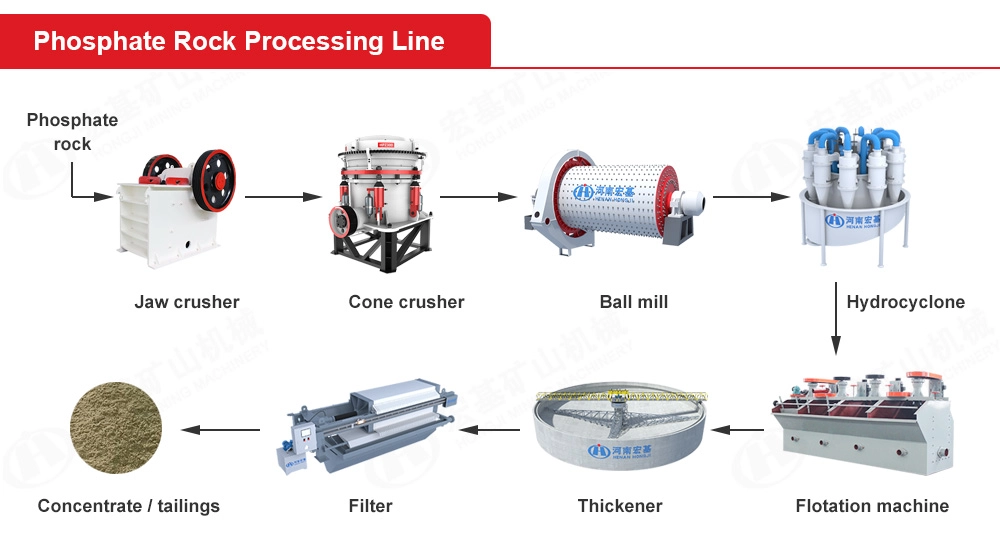
To efficiently extract phosphorus from phosphate rock, a complete phosphate rock processing plant usually includes four stages: crushing – grinding – beneficiation – dehydration.
Stage 1: Crushing
Phosphate rock is transported to the raw ore bin and enters the jaw crusher through the vibrating feeder. After coarse crushing, phosphate rock enters the cone crusher again for medium and fine crushing and is screened through the circular vibrating screen.
Process equipment: Vibrating feeder → Jaw crusher → Cone crusher → Circular vibrating screen

Stage 2: Grinding
This stage is a closed-circuit grinding process, which consists of a ball mill and a hydrocyclone to form a closed circuit. The material is fed to the ball mill by an electromagnetic vibrating feeder and is ground into phosphate rock powder.
Process equipment: Electromagnetic vibrating feeder → Ball mill → Hydrocyclone

Stage 3: Beneficiation
Phosphate particles from the cyclone overflow enter the flotation machine, adopting the reverse flotation process. After the process, the obtained products with high phosphorus content are phosphorus concentrates, which are pumped into the concentrate thickener.
Process equipment: Flotation machine

Stage 4: Dehydration
High-efficiency thickener is used to process the phosphate powders, and they are dehydrated by a vacuum filter. The phosphate concentrates are sent to the concentrate yard by a belt conveyor, and the tailings are pumped to the tailings pond.
Process equipment: Thickener → Filter




Submit Request


