Time:
CIL (Carbon-in-Leach) stands out in today's gold recovery work. It blends leaching and adsorption in one go. Traditional ways like CIP (Carbon-in-Pulp) or heap leaching keep these actions apart. But the CIL method boosts how well it works. It lets gold dissolve and stick to activated carbon at the same time. This mix cuts down on moving materials around. It also makes the whole process faster and gets more gold out.

The leaching method works well for pulling gold from ore. A Carbon-in-Pulp (CIP) plant is mainly suitable for argillaceous oxidized ore, flotation gold concentrate, and gravity tailings. These steps often need many tanks and longer times to finish. CIL systems use a tighter layout instead. By joining the stages, CIL lowers the money needed for setup while keeping output high. This helps both small and big gold processing plants run smoothly.
| Item | CIL | CIP |
| Leaching and Adsorption | Conducted simultaneously | Conducted separately |
| Equipment Quantity | Fewer | More |
| Investment Cost | Lower | Higher |
| Operating Complexity | Lower | Higher |
Crushing and Grinding: The ore gets ground fine enough to free the gold inside. Grind the gold-containing material to a particle size suitable for cyanidation, generally less than 28 mesh. Good grinding gives more surface for the next steps to act on.
Leaching and Adsorption: The cyanide pulp moves into the stirring adsorption tank (carbon slurry tank). Carbon is added to the leaching tank, where it adsorbs gold from the pulp and becomes gold-loaded carbon. This carbon adsorption process ensures that dissolved gold binds effectively to the activated carbon. Compared with heap leaching, where gold is extracted in separate stages over long periods, this combined approach accelerates gold recovery and reduces material handling.
Desorption and Electrowinning: In a closed system, gold-loaded carbon can be rapidly desorbed and electrolyzed into muddy gold and lean carbon under high-temperature and high-pressure conditions. This step frees pure gold from the carbon through electrolysis.
Smelting: It can smelt the obtained muddy gold into gold ingots after simple pickling and impurity removal. The end result is clean bullion ready for sale or further work.
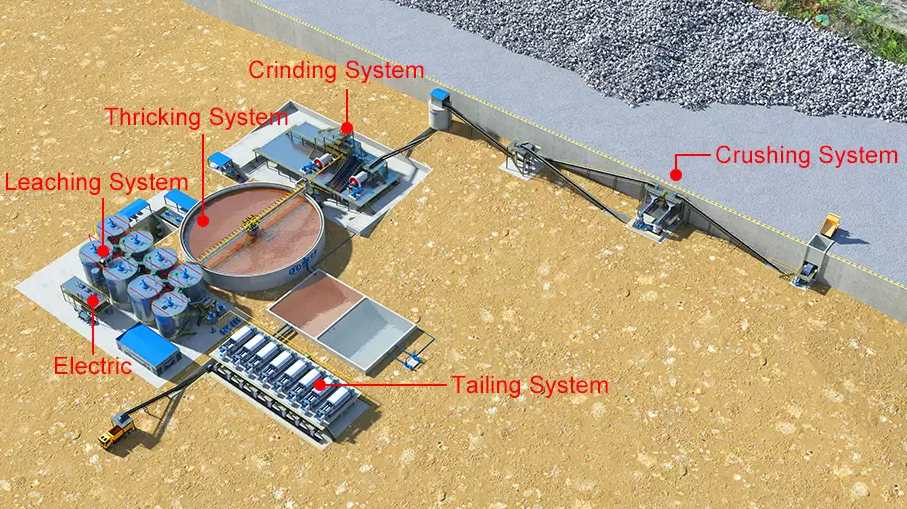
Cyanide remains key in gold extraction chemistry. It forms stable complexes with metallic gold, such as KAu(CN)₂. Gold CIP is one of the methods of gold extraction by cyanidation. It is a carbon adsorption process of monovalent gold cyanide [KAu (CN)2] after the cyanide leaching of gold-bearing materials. While heap leaching is effective for low-grade ores, the CIL method with integrated carbon adsorption achieves faster and higher gold recovery.
Activated carbon helps a lot because of its many small holes that trap metal ions. How fast it grabs the gold depends on temperature, particle size, and how active the carbon is. After desorption, regeneration keeps the carbon working well for many rounds. The desorbed lean carbon is first soaked in 1.5% ~ 2.0% nitric acid solution for 24 hours to remove calcium and then washed with clean water until neutral. The carbon is then returned to the adsorption cycle. This step lets the carbon go back into use without losing much of its power.
Ore type, grade spread, and particle size decide how well cyanide reaches the gold. Time spent in the leach tanks affects how complete the dissolution step becomes. Too little time leaves gold behind. Too much time is used up on chemicals. The amount of each reagent must match the carbon's ability to hold gold.
Automation now helps run modern CIL gold processing plant setups. Live checks track cyanide levels and carbon load. Better stirrers spread oxygen well and cut power use. This matters for large runs that need to stay green.
At Hongji Mine Machinery, we keep improving our designs with tank setups that can shift to fit different ores or output sizes. Our focus stays on using fewer chemicals while still achieving a good gold yield. This matches common goals in clean mineral work.
As a leading China gold processing plant manufacturer, we focus on full turnkey setups made for each client's ore. Our CIL gold processing systems use tank units with strong stirrers that cut power needs and raise metal recovery.
For instance, Hongji Mine Machinery’s Peru 150t/d Gold CIL processing plant shows this well. It ties crushing, grinding, leaching, and adsorption into one clear flow. The plant gets strong recovery from quartz vein gold ores.

We offer professional crusher, dryer, and rotary kiln manufacturing services, providing free design of the entire production line, including stationary crushers, mobile crushers, and grinding machines such as ball mill or rod mill used within beneficiation plants like copper ore or gold ore processing plants. These setups keep the crush stage and later chemical steps working well together inside any Chinese gold processing plant layout.
Our energy-saving gear includes rotary dryers to control moisture before leaching and ball mills made for fine grinding work. This readies the ore for cyanidation steps common in CIP or CIL circuits used in modern CIP gold processing plant operations worldwide.
Our teams give full help from lab tests to startups. Each job starts with ore tests that set the right flow sheet for the best gold pull using CIL technology inside our gold processing plants.
Through regular maintenance programs, we extend system longevity, reducing downtime associated with routine servicing across all installed units — an essential component of an effective long-term gold processing plant maintenance strategy, ensuring reliability throughout the operational lifespan.
A: CIL combines leaching and adsorption into one stage, which reduces overall process duration compared with CIP, where these occur sequentially, thereby improving overall efficiency within any CIP or CIL-based gold processing plant machinery configuration.
A: Yes, due to enhanced contact between cyanide solution and activated carbon surfaces, even low-grade ores processed through CIL gold processing achieve high recoveries, making it an ideal technology choice among China gold processing plant manufacturers handling complex deposits globally, including Ghana gold processing plant installations managed by our company.
A: Depending on ore characteristics, residence time typically ranges between twenty-four and forty-eight hours, covering the complete sequence from leach initiation through electrowinning, followed by smelting, producing bullion output consistent with commercial purity standards expected within the global gold processing plants network managed under our supervision at Hongji Mine Machinery.
A: Elution refers specifically to the desorption phase, where loaded carbon releases adsorbed metals under elevated temperature and pressure conditions, allowing a subsequent electrolysis recovery step central within both CIP gold processing and CIL gold processing plant operations worldwide.
Contact Us
WhatsApp:
Email:
Leave A Message

What Makes CIL Gold Processing a Preferred Method for Modern Gold Recovery? How CIL Differs from Traditional Gold Extraction Methods CIL (Carbon-in-Leach) stands out in today’s gold recovery work. It blends leaching and adsorption in one go. Traditional ways like CIP (Carbon-in-Pulp) or heap leaching keep these actions apart. But the CIL method boosts how well…

What Is Gold Froth Flotation and How Does It Work? The Basic Concept Behind Froth Flotation Froth flotation is a basic process in mineral processing. It separates useful minerals from waste rock by surface chemistry. In gold production, this method plays a key role in concentrating fine gold particles. These particles are often hard to recover…

Submit Request

